The parameter system of Schottky diodes (SBDs) covers four dimensions: electrical characteristics, thermal performance, reliability, and special application requirements. The following is a systematic review based on technical standards and engineering practices:
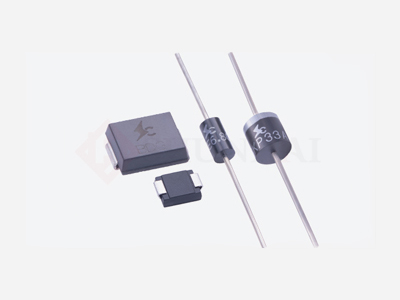
1、 Core electrical parameters
Positive voltage drop (VF)
Definition: The voltage drop when a diode is conducting in the forward direction.
Typical values: 0.2V-0.7V (silicon-based SBD), SiC SBD can be as low as 0.8V (high voltage scenario).
Impact: Directly affecting conduction loss, for every 0.1V decrease in VF, power consumption decreases by about 10%.
Reverse Voltage Resistance (VRRM)
Definition: The maximum reverse voltage that a diode can withstand.
Selection principle: More than 50% margin should be left (such as selecting VRRM ≥ 40V models for 24V circuits).
Packaging association: DO-214AA/AB packaging should be selected for high-voltage scenarios to avoid the risk of breakdown of plastic encapsulated devices.
Reverse leakage current (IR)
Definition: The small current that flows when reverse biased.
Typical values: μ A (silicon-based SBD), SiC SBD can be as low as nA level.
Impact: Excessive IR will increase static power consumption, and precision circuits need to choose IR<1 μ A models.
Reverse recovery time (trr)
Definition: The recovery time required for a diode to transition from conduction to cutoff.
Typical value:<10ns (SBD), much lower than the 50ns of fast recovery diode (FRD).
Application scenario: High frequency switching power supplies (such as those above 100kHz) require TRR<35ns models.
Junction capacitance (Cj)
Definition: Parasitic capacitance of a PN junction diode.
Typical value: 0.1pF-10pF (decreases with increasing voltage).
Impact: Excessive Cj will result in poor high-frequency response, and the RF circuit should choose a Cj<1pF model.
2、 Thermal performance parameters
Junction temperature (Tj)
Definition: The operating temperature of the PN junction of a diode.
Limit value: Tj<150 ℃ for silicon-based devices, and up to 175 ℃ for SiC devices.
Calculation method: Tj=Ta+P × θ JA (Ta is ambient temperature, P is power consumption, θ JA is thermal resistance).
Thermal resistance (θ JA)
Definition: The ratio of the temperature difference between the junction temperature and the ambient temperature to the power consumption.
Typical values:
SOD-123:θJA≈200℃/W
SMA/SMB:θJA≈150℃/W
TO-277/D2PAK:θJA<50℃/W
Selection principle: Low θ JA packaging should be selected for high-power scenarios to avoid overheating and failure.
3、 Reliability parameters
Lifetime (MTBF)
Definition: Mean time between failures.
Test standard: Confirm that the leakage current change after 1000 hours is less than 5% through HTRB (high temperature reverse bias) test.
Typical value: MTBF>1 million hours for industrial grade devices.
Anti static electricity capability (ESD)
Definition: The ability of a diode to withstand electrostatic discharge.
Test standard: Compliant with the Human Body Model (HBM) 2kV/4kV level.
Enhancement plan: Some models integrate TVS diodes, increasing ESD tolerance by 10 times.
mechanical strength
Plug in packaging: Priority is given to DO-15 (metal glass packaging) instead of DO-41 (plastic packaging), which improves vibration resistance by three times.
Surface mount packaging: Choose models with corner reinforcement (such as SMCJ series) to avoid welding cracks.
4、 Special application parameters
Automotive Grade Certification (AEC-Q101)
Requirement: The vibration tolerance level should meet the ISO 16750-3 standard after passing the temperature range test from -55 ℃ to 150 ℃.
Typical models: B340A-13-F, MBR20100CT-Q.
Radiation resistance
Definition: The stability of a diode in a radiation environment.
Test criteria: Total dose radiation (TID)>100kRad (Si), single particle effect (SEE) immunity.
Application scenarios: Satellite power systems, aerospace grade sensors.
Flexible electronic compatibility
Technological breakthrough: Adopting a composite structure of nano silver wires and Schottky junctions to achieve a bendable diode (bending radius<1mm).
Application scenarios: Wearable devices, flexible display screens.
5、 Parameter selection decision framework
Low voltage drop scenario (such as LDO): Prioritize VF<0.3V models (such as BAT54C), pay attention to IR and Cj balance.
High frequency switch scenario (such as SMPS): Select trr<35ns model (such as MBR3045PT) and verify the package thermal resistance.
Automotive grade applications: Confirm AEC-Q101 certification, focusing on temperature range and vibration tolerance.
Special environmental scenarios (such as aerospace): Verify radiation resistance and mechanical strength.
Through the above parameter system, a Schottky diode selection scheme suitable for different scenarios can be constructed. In practical engineering, it is necessary to combine circuit simulation and reliability testing verification to ensure that the parameters are in deep agreement with the requirements. With the development of SiC materials and integrated technology, the potential of Schottky diodes in high-temperature, high-frequency, and high-power scenarios will be further unleashed.


